
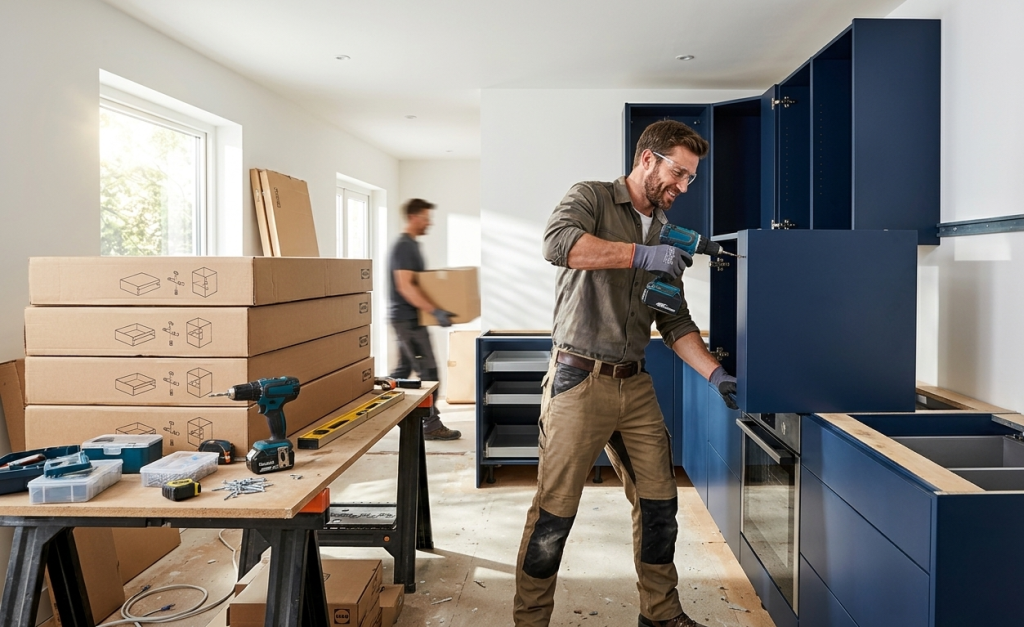
When most people hear the words “flat-pack kitchen,” they immediately think of one thing: cheap.
Sometimes, they even assume cheap means low quality.
But after years of managing residential remodels, tracking property investment returns, and coordinating trade schedules, I’ve found the biggest myth about flat-pack kitchens isn’t that they’re structurally inferior. It’s that people assume they are going to be dramatically cheaper than a custom build.
The reality on the ground is often very different. If you’re weighing up your options, understanding the real economics of a fast kitchen remodel will completely change how you approach your project.
Flat-Pack Kitchens Aren't Always the Cheapest Option
Many first-time flippers and homeowners are surprised when they compare the true flat pack kitchen costs against a quote from a local custom cabinet maker.
Yes, the base modular cabinets appear significantly cheaper at first glance. However, once you factor in the essential extras—delivery fees, end panels, cover strips, stone or timber benchtops, premium hardware, appliances, and professional trades for assembly—the price gap narrows considerably.
In some cases, the bottom-line difference between a high-quality flat-pack setup and a custom-built kitchen may only be a few thousand dollars. That is often a far smaller margin than people expect when they embark on a custom kitchen vs flat pack comparison.
So, if flat-packs aren’t always saving you a fortune on raw materials, why do experienced property renovators and investors continue to rely on them?
The answer has very little to do with the receipt from the checkout.
The Real Advantage Is Speed (And Holding Costs)
In the property industry, time isn’t just money—it is literally your profit margin bleeding away.
Every single week a project drags on is another week of mortgage interest repayments, council rates, insurance, utilities, and builder holding costs.
- If you are modernizing an investment property, it’s another week without rental income.
- If you are renovating to flip, it’s another week before the property can hit the market.
These hidden structural expenses add up fast. A traditional custom kitchen build involves a lengthy, multi-stage pipeline:
- Initial design consultation
- Precise on-site measurements (usually after plastering is 100% complete)
- Design revisions and formal quoting
- Off-site manufacturing and assembly
- Delivery and meticulous trade installation
Even when working with an exceptional cabinet maker, this workflow can easily take anywhere from 4 to 8 weeks during peak building seasons. Meanwhile, your entire job site sits completely idle waiting for cabinetry to arrive. If you want to avoid these compounding delays, mastering your initial renovation planning is critical.
Why IKEA Has Become the Renovator's Favourite

Image Source: Inside Retail AU
This bottleneck is exactly where an IKEA kitchen renovation changes the entire playbook. Instead of waiting a month or more for custom joinery to be fabricated off-site, a renovator can use online software, finalize a layout, buy the stock, and begin the house renovation timeline almost immediately.
Investor Example: I’ve personally run projects where the kitchen layout was finalized on a Monday, the flat-pack boxes were delivered on Tuesday, and the installation trades commenced on Wednesday morning.
Try achieving that turnaround time with a boutique custom joinery shop during a metropolitan property boom. For a professional working to a strict schedule, that logistical speed is worth far more than a minor saving on material costs.
Every Week Matters: The Profit Math
Many amateur renovators obsess over slashing direct material costs but completely ignore the devastating financial impact of project delays.
Imagine two identical property renovations:
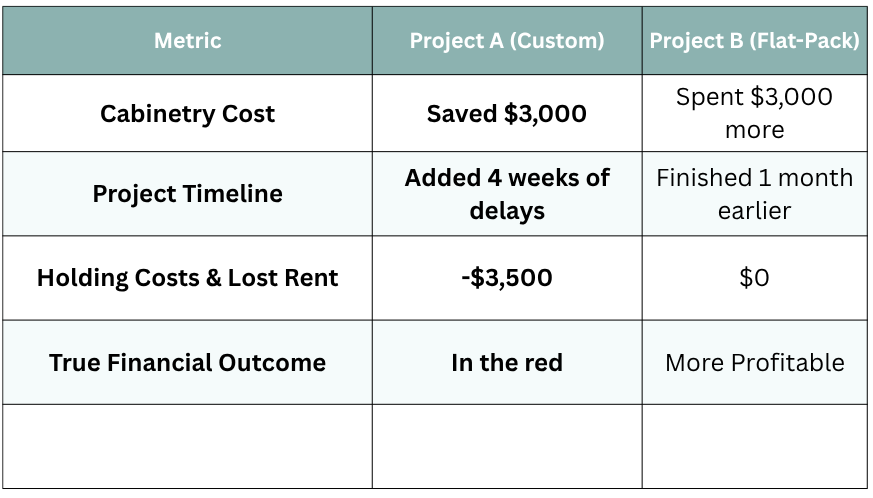
Once you accurately calculate interest payments, hard holding costs, missed rent, and opportunity cost, the cheaper invoice rarely equals the best financial decision. Professional renovators aren’t just buying cabinets; they are buying time.
Cabinet Quality Has Evolved Significantly
Another common misconception is that flat-pack systems are inherently fragile. While there are certainly low-grade, flimsy options floating around the budget market, premium modular systems have evolved massively.
Modern systems utilize highly resilient cabinet carcasses and partner with top-tier hardware manufacturers. For instance, standard IKEA drawers and hinges are manufactured by Blum—the exact same hardware brand specified by high-end, luxury custom cabinet makers.
When you execute the layout correctly, use proper leveling techniques, and fine-tune the hardware adjustments, the vast majority of home buyers will struggle to spot the difference between a well-finished flat-pack and an expensive custom alternative. (To see the tools and components we recommend using to get that flawless finish, check out our recommended products page).
Accessibility and Spare Parts Convenience
There are brilliant specialist flat-pack manufacturers across Australia offering custom routing, unique sizing, and bespoke timber veneers. However, many regional or suburban renovators simply don’t have effortless geographical access to these niche facilities.
This is where the massive footprint of a major brand wins on convenience. If a trade accidentally damages a door on-site or a design change happens mid-build, you can simply drive to a local showroom, grab a replacement part off the rack, and keep the momentum going. That level of accessibility removes a massive layer of risk and anxiety from your overall project management.
The Bottom Line for Smart Renovators
If you are choosing a modular kitchen purely because you assume it’s the absolute cheapest way to buy timber panels, you are focusing on the wrong metric.
The true, undeniable value of a flat-pack layout lies in its speed, predictability, and immediate availability. A high-quality modular setup allows you to push a project forward rapidly, protect your timeline from costly trade delays, and get your property leased or sold faster.
If you are getting ready to kickstart your next project, explore our comprehensive kitchen renovation tips and design guides to make sure your layout is flawless before ordering.
The smartest investors understand that the ultimate goal isn’t just to spend less on materials—it’s to finish the job sooner. Because every day your site sits empty is another day your capital isn’t working for you.